

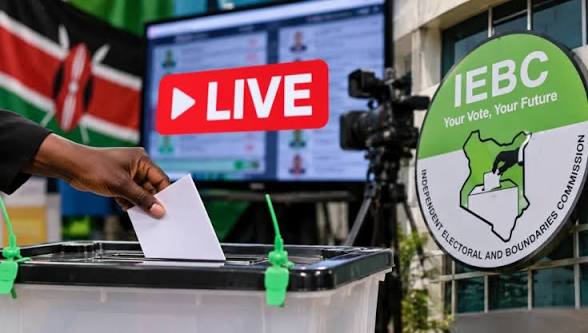
There seems to be a lot of misunderstanding surrounding the debate on livestreaming election results. Let’s get one thing straight: nobody is proposing that cameras be installed inside polling stations to livestream people casting their votes. The conversation is about livestreaming election data, not voters.
Think about how football works. When Manchester United plays Arsenal, millions of fans can follow the match in real time. They can see the score, possession statistics, corners, yellow cards and other match details as they happen. Nobody needs to livestream the dressing room or broadcast every movement of individual players. What matters is that verified match information is made available to the public as the game progresses.
There is no reason elections cannot operate on a similar principle.
From the moment polling stations open, the KIEMS kits identify voters and record turnout. That information can be transmitted to IEBC servers and made available through a public portal throughout the day. This means Kenyans would not have to wait until evening or the following day to know how many people have voted. They could follow turnout figures as they come in from Mombasa, Bungoma, Eldoret, Nairobi, Kisumu and every other part of the country.
By the time polling closes, the public would already have a clear picture of voter turnout at every polling station.
Take an example of a polling station with 1,000 registered voters. If the KIEMS data shows that 60 per cent turned out, that means approximately 600 people voted. If the final results later reflect more votes than the recorded turnout, there would be an immediate and legitimate reason to demand an explanation. The information would already be in the public domain, making it harder for inconsistencies to go unnoticed.
This is what transparency should look like.
It would also establish a verifiable trail of information from the opening of polling stations to the final declaration of results. Citizens, political parties, election observers and journalists would have an opportunity to independently compare four important records:
– Voter turnout recorded and transmitted through KIEMS.
– Physical results declared and displayed at individual polling stations.
– Official results forms uploaded to the IEBC public portal.
– Results electronically transmitted to IEBC servers.
The bigger question is what happens to the results after they leave the polling station.
IEBC has traditionally described figures appearing on its public portal as provisional. But these figures are not simply estimates or numbers generated from nowhere. They originate from results declared after counting at individual polling stations and recorded on official forms.
So, why should Kenyans continue seeing them merely as provisional figures when the results have already been counted, declared at the polling station, documented and electronically transmitted?
The public deserves a clear explanation of that distinction. Once results have been officially declared at a polling station, there should be a transparent mechanism for making those results immediately accessible and independently verifiable.
This is not just about making election information available. It is about protecting the integrity of the entire process. When turnout figures and declared results are published in real time, political parties, observers and ordinary citizens can identify discrepancies early rather than waiting until suspicions emerge after the election.
Transparency should not start when IEBC is preparing to announce the winner. It should begin the moment the first voter is identified and continue until the last polling station has transmitted its declared results.
Let nobody distort the argument: we are not asking IEBC to livestream voters casting their ballots. We are asking it to livestream verified election data, voter turnout and declared results as they are generated and transmitted.
That is a reasonable demand in a modern democracy. Kenyans should not have to wait until an election is over to access information that can be made available throughout the process.
If technology can give football fans live scores from anywhere in the world, surely our electoral system can give voters transparent, real-time access to election data.